

.png)
Gravel Driveway Maintenance for Lasting Results
A gravel drive should look welcoming, drain well and stand up to daily cars without turning into a patchwork of ruts and bare areas. Regular gravel driveway maintenance is the straightforward way to protect that clean, traditional finish and avoid a larger repair later. For homeowners across Berkshire and Surrey, a little timely care can keep the entrance to the property looking smart through wet winters, dry summers and busy family life.
What keeps a gravel driveway in good condition?
A well-built gravel driveway is naturally hard-wearing, but it is not completely maintenance-free. Tyres push stone outwards, rain carries fine material downhill and foot traffic can create uneven patches around gates, bins and parked vehicles. The aim is not to keep every stone perfectly still. It is to maintain an even, compacted surface with good drainage and enough gravel across the whole drive.
The quality of the original installation makes a real difference. A solid sub-base, suitable edging and the right depth of aggregate all reduce future upkeep. If a driveway was laid directly onto soil, or has no proper support beneath it, simply adding more stone may improve its appearance briefly without solving the reason it is sinking or rutting.
For most residential driveways, angular gravel is a better practical choice than rounded pebbles. Its rough edges lock together under pressure, making it more stable for cars. A 20mm gravel is often a good balance between a neat appearance and comfortable walking, although the best choice depends on the driveway gradient, vehicle use and the look of the home.
Your gravel driveway maintenance routine
The best approach is frequent light attention rather than waiting for the surface to become difficult to use. Walk the drive every few weeks, particularly after heavy rain or a spell of frost. Look for stones gathering at the edges, tyre tracks forming in the same place and puddles that take too long to disappear.
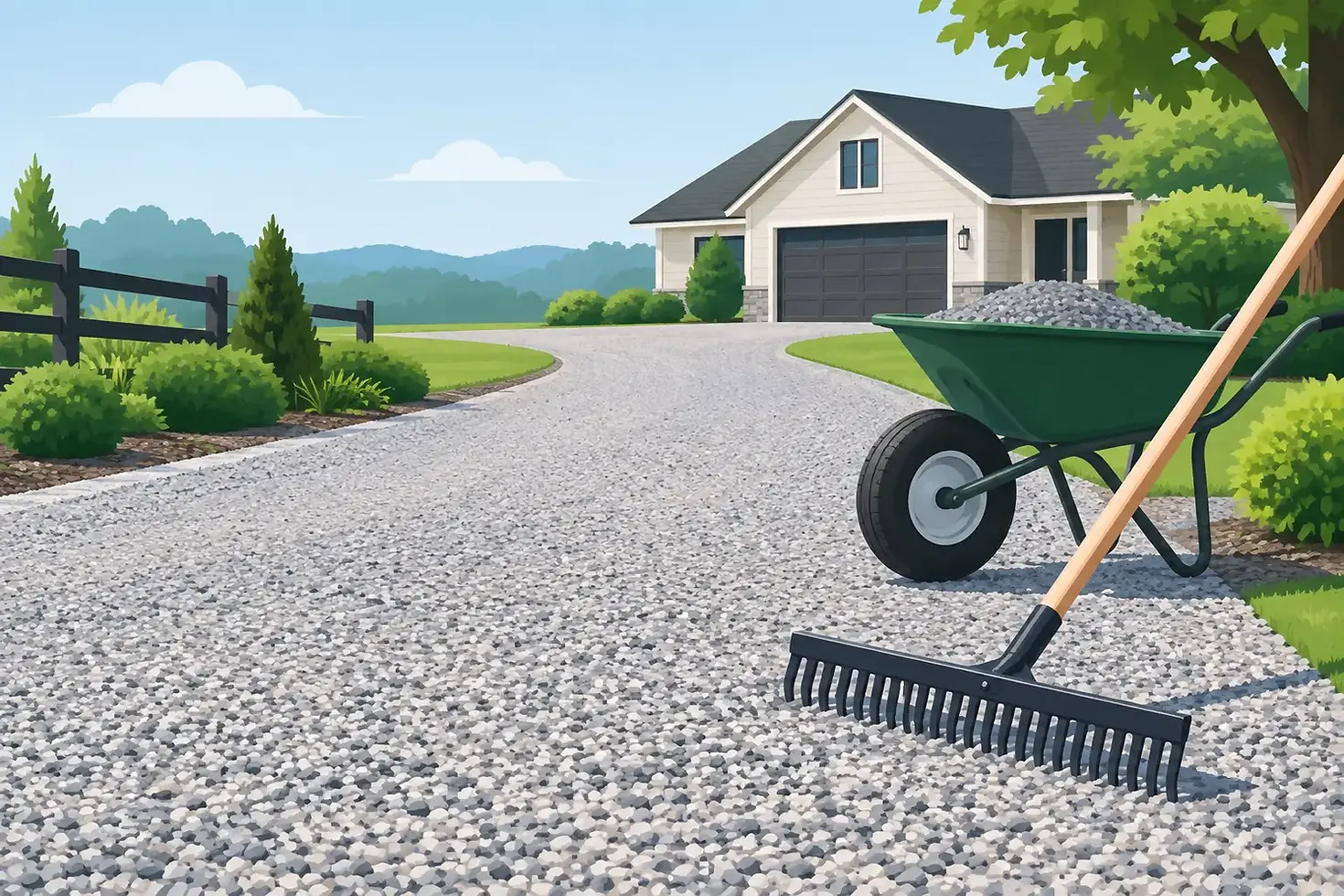
Rake displaced gravel back towards the centre with a wide landscape rake. Work in small areas and use gentle strokes so you are redistributing the stone rather than digging into the base. Pay particular attention to the entrance, turning areas and spaces beside parked cars, as these receive the most movement.
Avoid using a leaf blower at full power close to the surface. It may be convenient for dry leaves, but it can also blow smaller stones into flower beds, paths and the road. A stiff outdoor broom or a rake is normally more controlled. Removing leaves, mud and fallen blossom matters because organic debris breaks down over time and creates a growing medium for weeds.
It also helps to vary where vehicles are parked when space allows. Repeatedly stopping in exactly the same place concentrates the load and makes depressions more likely. Do not spin tyres when pulling away, especially on a slope, as this scatters gravel and loosens the surface.
Topping up gravel at the right time
Every gravel drive loses some material over the years. Stones migrate beyond the edging, stick in tyre treads or settle gradually into the surface. A top-up restores colour, coverage and stability before the sub-base is exposed.
There is no single timetable for this. A lightly used driveway may only need a modest top-up every few years, while a large household with several cars may need attention sooner. If you can see the base beneath the gravel, notice bare tracks, or find the surface feels thin underfoot, it is time to add more material.
Match the existing gravel as closely as possible in size, colour and shape. Mixing a very fine aggregate with larger decorative stones can affect drainage and make the finish look uneven. Spread new gravel in dry conditions, rake it level and allow normal vehicle use to help it settle. If the driveway has become deeply uneven, repair and regrade the base first rather than using fresh gravel to fill major hollows.
Stop weeds before they take hold
A few weeds on a gravel driveway are normal, particularly in spring and early summer. Seeds blow in from surrounding gardens and germinate in dust, leaves and organic matter sitting between stones. They do not necessarily mean the weed membrane beneath the driveway has failed.
Remove small weeds as soon as they appear, ideally after rain when the roots release more easily. For larger areas, use an appropriate weed treatment in line with the product instructions and keep children and pets away until it is safe to return. A repeat treatment may be needed for established weeds, as cutting back visible growth alone rarely deals with the roots.
Do not rely on salt, bleach or household chemicals. They can damage nearby planting, affect soil and create unwanted runoff. Keeping the surface clear of debris is a safer long-term habit and reduces the number of seeds able to establish in the first place.
Deal with ruts, potholes and sinking properly
Ruts are usually a warning that the driveway needs more than a quick rake. Shallow tyre marks can often be levelled by pulling nearby gravel into the depression and compacting it with a hand tamper. If they return quickly, the gravel layer may be too thin or the material beneath may be moving.
Potholes and sinking areas need to be opened up, not just covered over. Remove loose gravel from the affected section, excavate any soft or contaminated base, and rebuild it with suitable compacted sub-base before replacing the gravel. This stops the repair from disappearing into the same weak ground after the next period of rain.
Water is often the underlying cause. Check whether downpipes discharge directly onto the driveway, whether the surface slopes towards the property, or whether edging has trapped water at the side. Gravel is permeable, but only when water has somewhere sensible to go. On clay-heavy ground or sloping sites, a drainage solution, channel or revised levels may be needed to protect the drive and nearby building.
Protect the edges and entrance
Strong edging is one of the most useful features of a long-lasting gravel driveway. It holds stones in place, defines the shape of the drive and prevents the surface spreading into lawns or beds. Inspect timber, stone, block or metal edging each season for movement, cracking or low sections where gravel is escaping.
The entrance deserves extra care because vehicles cross it with speed and turn their wheels there. Sweep loose stone back from the pavement and road regularly. This keeps the frontage tidy, reduces slip risks and gives visitors a better first impression before they reach the front door.
If gravel constantly travels beyond the boundary, consider whether the entrance needs firmer edging, a stabilisation grid or a short section of another surface material. This is particularly useful on steep drives, where loose stone can work its way downhill after rain and daily use.
Seasonal care for a tidy driveway
Weather changes how a gravel surface behaves, so a quick seasonal check is worthwhile.
In spring, clear winter debris, treat early weed growth and rake gravel back into thin areas.
In summer, check dusty patches and exposed base material, then plan a top-up before they worsen.
In autumn, remove leaves regularly and clear gullies or drainage channels before prolonged rain arrives.
In winter, avoid pushing snow into piles that drag gravel with them. Use a plastic shovel carefully and leave a thin layer of snow rather than scraping hard against the stones.
During icy weather, use a grit product suitable for the surface and apply it sparingly. Heavy use of salt can leave residue and affect planting alongside the drive. Gravel can provide useful natural grip, but it should still be treated carefully where paths, steps or slopes are involved.
When professional repairs are the better value choice
There is a point where DIY maintenance stops being the economical option. Persistent puddling, deep wheel ruts, loose edging, widespread weeds and repeated loss of gravel can all point to a construction issue below the surface. A proper assessment can identify whether the answer is localised repair, improved drainage, new edging or a full rebuild.
For a driveway that sees regular family cars, deliveries and visitors, a stable foundation is what saves money over time. Lay Away UK can advise on practical gravel driveway repairs and installations that suit the property, the ground conditions and the finish you want, without overcomplicating the process.
A gravel driveway does not need constant attention to look its best. Keep it clean, rake it little and often, act early when water or ruts appear, and it will continue to give your home the smart, welcoming approach it deserves.


Comments