

.png)
Driveway Edging Options UK: Which Suits You?
A driveway can look freshly laid on day one, but it is the edge that often decides how well it keeps that appearance. The right driveway edging options UK homeowners choose do more than frame the surface neatly. They hold materials in place, protect borders and lawns, manage the change in level between areas, and give the whole front of the property a properly finished look.
For homes across Berkshire and Surrey, edging needs to cope with real everyday use: cars turning in, wet weather, bins being wheeled out and children crossing from drive to garden. The best choice depends on your driveway material, the shape of the space, drainage requirements and the style of your home.
Why driveway edging is worth getting right
Edging is sometimes treated as a finishing touch, yet it is an important structural part of many driveway installations. Block paving, gravel and resin-bound surfaces all benefit from a firm, well-installed boundary. Without it, the outer edge can spread, crumble, sink or become untidy over time.
A strong edge also creates a clean division between the driveway and a lawn, flower bed, path or patio. That matters if you are investing in kerb appeal. A straight, consistent line makes a modest driveway look smarter, while a carefully shaped edge can soften a wide frontage or guide vehicles neatly towards the parking area.
There is no single best material for every property. A contemporary new-build may suit slim metal edging or a crisp charcoal block border. A traditional Berkshire home may look better with natural stone setts or a warm-toned brick kerb. More importantly, the edging must be installed on a suitable base and secured correctly, rather than simply placed on the surface.
Driveway edging options UK homeowners use most
Block paving kerbs and soldier courses
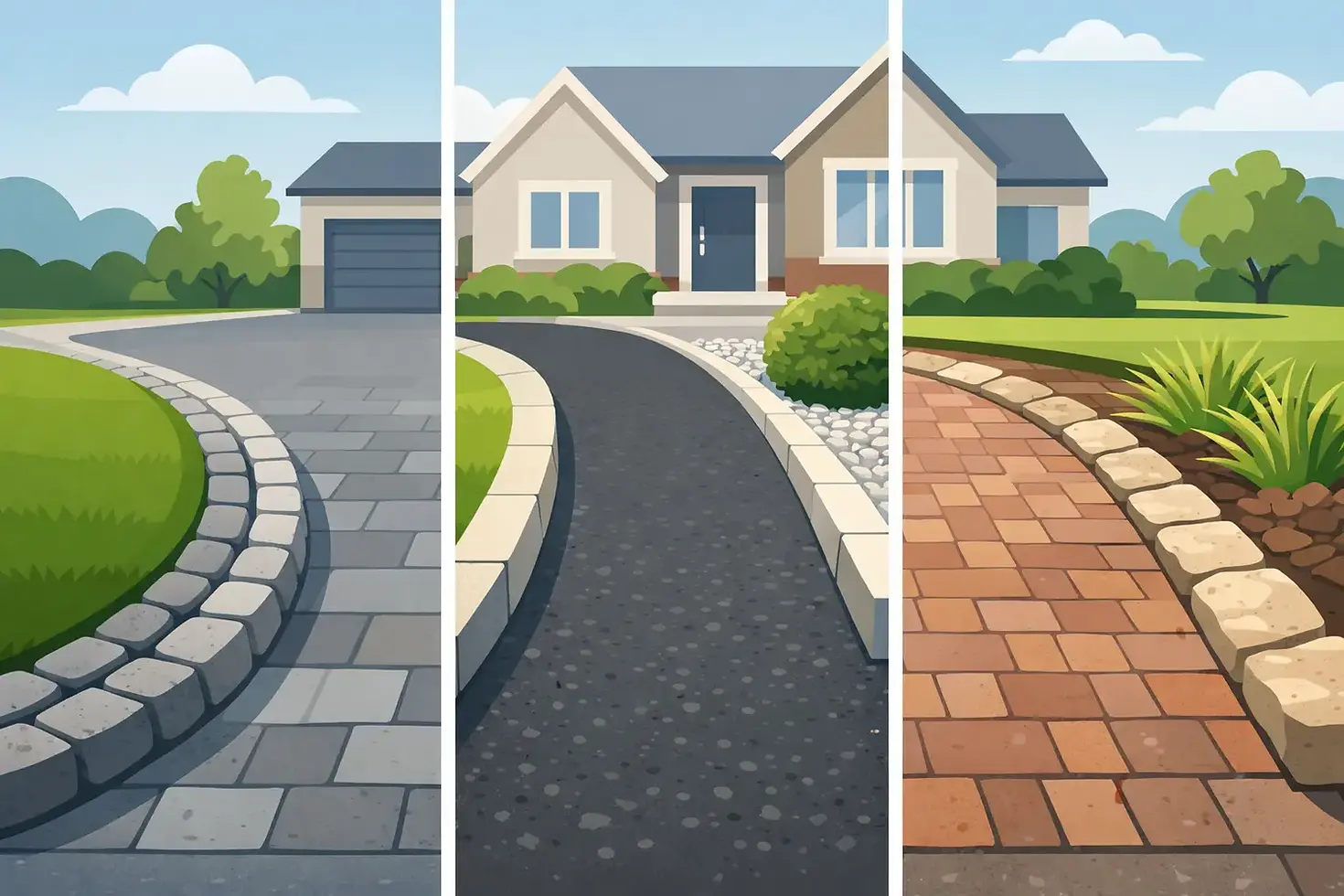
Block kerbs are one of the most popular choices because they are hard-wearing, versatile and easy to coordinate with a block-paved driveway, patio or pathway. They can be laid upright as a traditional kerb, flat as a border, or on edge in a soldier course. This gives plenty of control over the final look.
For a subtle finish, choose an edging block that closely matches the main driveway. For stronger contrast, a charcoal, black or natural stone-coloured border can define the drive and make lighter paving stand out. Block edging is particularly effective around curves, although tighter curves need careful cutting and setting out to avoid awkward gaps.
It is a sensible option for driveways with regular vehicle use, provided the blocks are bedded and restrained properly. The main consideration is maintenance: joints may need occasional attention, especially if moss or weeds are allowed to establish.
Concrete kerbs
Concrete kerbs are a practical, dependable choice for larger driveways, tarmacadam surfaces and areas where a clear raised boundary is useful. They are available in several profiles, from standard road-style kerbs to smaller decorative units that feel more at home on a residential property.
Their biggest advantage is strength. A properly installed concrete kerb can stand up well to tyres, repeated turning and the occasional accidental knock. They are also useful where the driveway sits slightly above a lawn or planting area and you need to retain the surface neatly.
The trade-off is appearance. Plain grey concrete can feel utilitarian beside a character property or premium resin driveway. It can, however, be a very good fit for a clean, straightforward tarmac drive, and coloured or textured kerb units offer a more refined alternative.
Natural stone setts
Granite or sandstone setts bring weight, character and a more premium feel to a driveway. Their varied texture and tone work especially well with period homes, rural-style properties and entrances where you want the border to be a visible design feature rather than simply a restraint.
Granite setts are exceptionally tough and pair well with tarmacadam, gravel, resin bound surfacing and block paving. A line of grey granite setts around a black tarmac drive, for example, creates a smart, timeless contrast. Sandstone setts can produce a softer, warmer result, although the stone and finish should be chosen with vehicle traffic and local weather in mind.
Stone edging generally costs more than standard concrete or block options. It also needs skilled installation to ensure the line is even and each sett is firmly bedded. When it is done properly, though, it can add lasting value and a finish that does not date quickly.
Metal edging
Steel edging gives a slim, modern line that is popular around contemporary resin-bound driveways, gravel areas and landscaped front gardens. It can be used to create gentle curves with less visual bulk than a kerb, making it ideal where you want the driveway to blend into the garden rather than appear heavily bordered.
Galvanised steel resists corrosion, while weathering steel develops a rust-coloured protective finish that can suit natural planting schemes. Metal edging is not usually the first choice for an exposed edge that will regularly be driven over. It is better placed between a driveway and a lawn, decorative aggregate bed or planted border, where it can retain materials without taking repeated impact from tyres.
Its clean appearance is the attraction, but the detailing matters. The top edge should be safely installed, the joins should be neat, and the surrounding ground levels need to be planned so it does not become exposed as soil or gravel moves.
Brick edging
Clay brick edging is an excellent way to echo the brickwork of the house, garden wall or existing path. Red, buff and mixed-tone bricks can add warmth and character, particularly on traditional homes where a modern concrete kerb would look out of place.
Bricks can be laid flat, upright or angled depending on the desired effect. They are often used as a contrasting perimeter to block paving or as a boundary around a gravel drive. Quality matters here. Bricks intended for driveway use need to be durable enough for external conditions and installed on a stable foundation, not laid directly into loose soil.
Matching edging to your driveway surface
A gravel driveway relies heavily on its edge restraint. Gravel naturally migrates under tyres and foot traffic, so a raised or firm boundary such as block kerbs, concrete kerbs, bricks or stone setts is usually the most practical choice. Metal edging can work where traffic is light, but it needs to be sufficiently secure and high enough to contain the gravel.
Resin-bound driveways have a smooth, attractive finish that benefits from a crisp frame. Block borders, stone setts and contrasting resin edges can all work well. The key is to make sure the base and drainage design are right before the resin is laid. An attractive edge cannot compensate for movement or poor preparation below the surface.
For block paving, a contrasting soldier course or purpose-made kerb is often the natural answer. It reinforces the outer perimeter while giving the layout a more deliberate design. On tarmacadam, stone setts, concrete kerbs and block borders all create a tidy transition and help prevent the edge of the tarmac from breaking away.
Practical details that affect the result
Before deciding on colour and style, consider how vehicles use the driveway. If cars reverse close to the lawn or regularly turn across the edge, choose a substantial kerb or sett that can tolerate contact. Low-profile decorative edging may look appealing but is unlikely to last if it is repeatedly mounted by tyres.
Drainage should also be considered from the outset. Surface water must be directed responsibly, and edging can influence where water runs. In some cases, drainage channels, falls or permeable materials will be needed alongside the border. This is particularly relevant when replacing an existing front garden with a larger hard surface.
Think about future maintenance as well. Gravel needs occasional raking back into place. Block and brick joints may need cleaning or re-sanding. Natural stone is durable but can benefit from periodic washing. The right installation makes every option easier to live with, which is why preparation and levels should never be rushed.
Choosing a finish that suits your home
The most successful driveway borders usually feel connected to the rest of the property. Pick up a colour from the house brickwork, roof tiles, front door or garden paving. A dark border can make a pale driveway look sharp and modern, while warm bricks or sandstone can make a broad frontage feel more welcoming.
Avoid choosing solely from a small sample. Look at materials outside in natural light and consider them alongside the driveway surface, walls, gates and planting. A good installer will help you balance appearance with durability, budget and the way your household uses the space.
At Lay Away UK, we believe a driveway should be built as a complete job, not just a surface with a border added at the end. A well-chosen edge protects your investment, keeps the finish looking tidy and gives you confidence that the driveway will serve your home well for years to come. If you are planning a new driveway, allow time to discuss the edging at the design stage - it is one of the smallest details that can make the biggest difference.


Comments